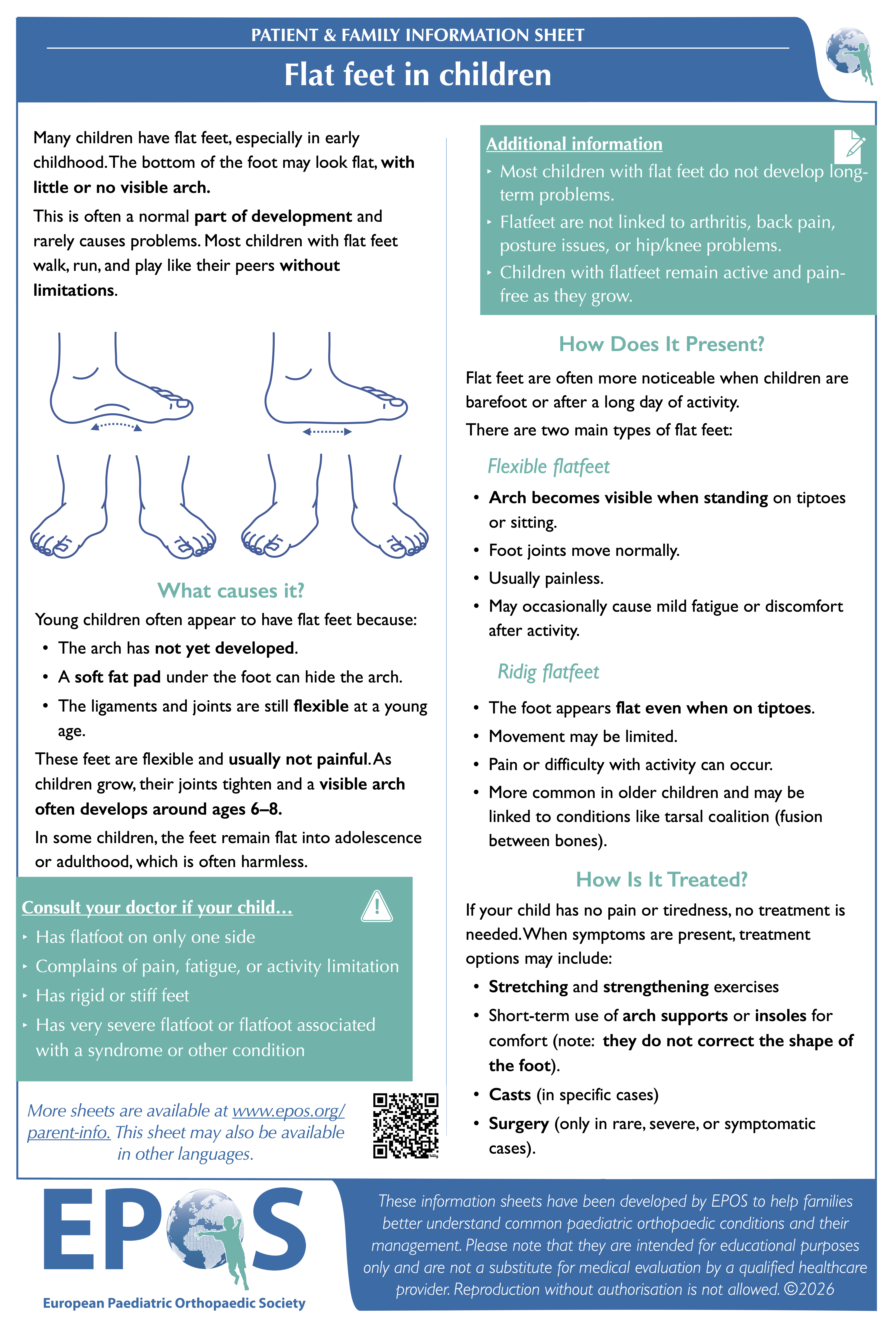
What are flat feet?
Many children have flat feet, especially in early childhood. The bottom of the foot may look flat, with little or no visible arch.
This is often a normal part of development and rarely causes problems. Most children with flat feet walk, run, and play like their peers without limitations.
What causes it?
Young children often appear to have flat feet because:
- The arch has not yet developed.
- A soft fat pad under the foot can hide the arch.
- The ligaments and joints are still flexible at a young age.
These feet are flexible and usually not painful. As children grow, their joints tighten and a visible arch often develops around ages 6–8.
In some children, the feet remain flat into adolescence or adulthood, which is often harmless.
How does it present?
Flat feet are often more noticeable when children are barefoot or after a long day of activity.
There are two main types of flat feet:
Flexible flat feet
- Arch becomes visible when standing on tiptoes or sitting.
- Foot joints move normally.
- Usually painless.
- May occasionally cause mild fatigue or discomfort after activity.
Ridig flat feet
- The foot appears flat even when on tiptoes.
- Movement may be limited.
- Pain or difficulty with activity can occur.
- More common in older children and may be linked to conditions like tarsal coalition (fusion between bones).
How is it treated?
If your child has no pain or tiredness, no treatment is needed. When symptoms are present, treatment options may include:
- Stretching and strengthening exercises
- Short-term use of arch supports or insoles for comfort (note: they do not correct the shape of the foot).
- Casts (in specific cases)
- Surgery (only in rare, severe, or symptomatic cases).
Additional information
- Most children with flat feet do not develop long-term problems.
- Flatfeet are not linked to arthritis, back pain, posture issues, or hip/knee problems.
- Children with flatfeet remain active and pain-free as they grow.
Consult your doctor if your child…
- Has flatfoot on only one side
- Complains of pain, fatigue, or activity limitation
- Has rigid or stiff feet
- Has very severe flatfoot or flatfoot associated with a syndrome or other condition
Download the information sheet for flat feet
Click on the image below to download the printable information sheet for flat feet.