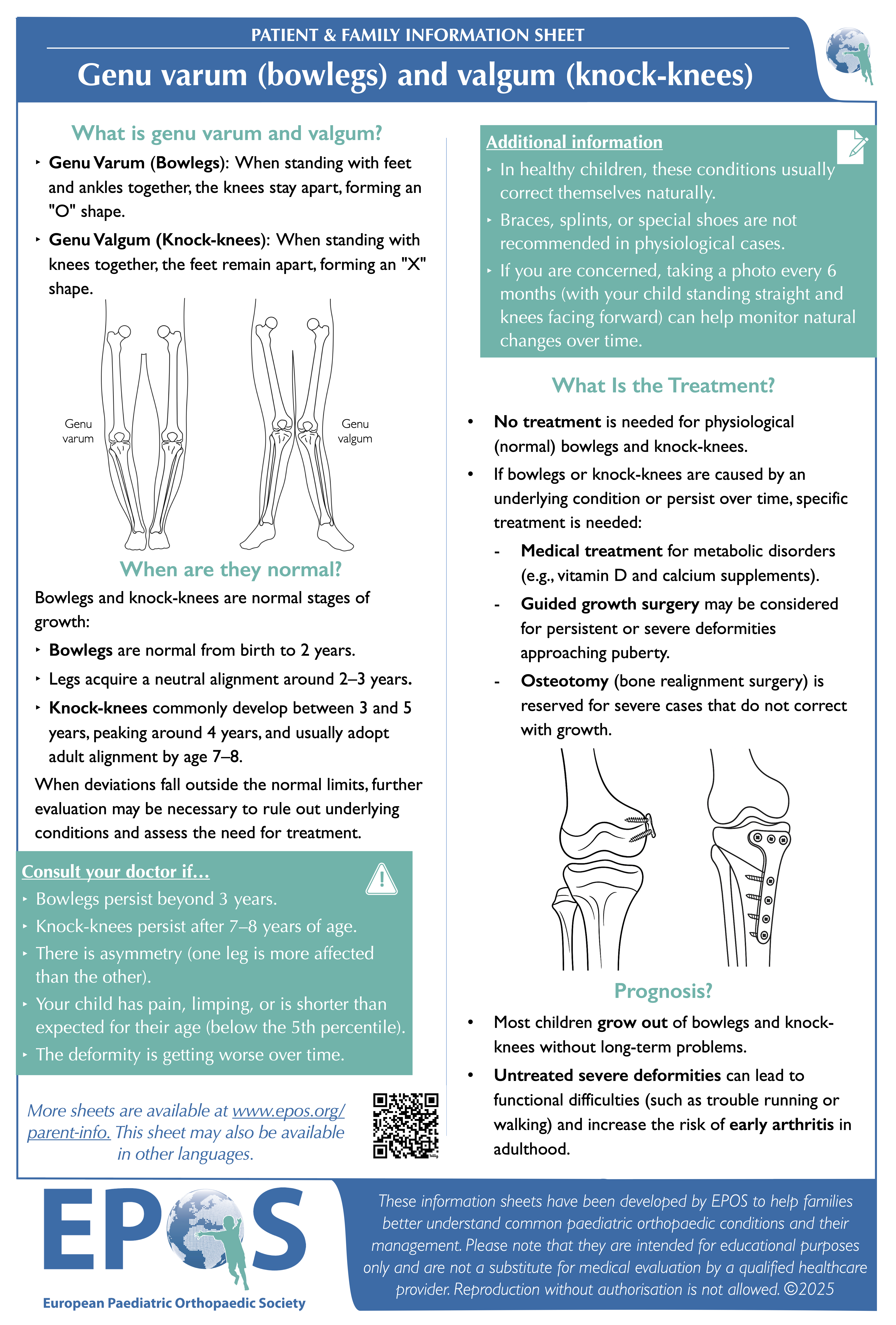
What is genu varum and valgum?
- Genu Varum (Bowlegs): When standing with feet and ankles together, the knees stay apart, forming an "O" shape.
- Genu Valgum (Knock-knees): When standing with knees together, the feet remain apart, forming an "X" shape.
When are they normal?
When deviations fall outside the normal limits, further evaluation may be necessary to rule out underlying conditions and assess the need for treatment.
How Is It Diagnosed?
Diagnosis is clinical—based on symptoms and physical exam. X-rays are not usually needed, unless symptoms are atypical.
What is the treatment?
- No treatment is needed for physiological (normal) bowlegs and knock-knees.
- If bowlegs or knock-knees are caused by an underlying condition or persist over time, specific treatment is needed:
- Medical treatment for metabolic disorders (e.g., vitamin D and calcium supplements).
- Guided growth surgery may be considered for persistent or severe deformities approaching puberty.
- Osteotomy (bone realignment surgery) is reserved for severe cases that do not correct with growth.
What is the prognosis?
- Most children grow out of bowlegs and knock-knees without long-term problems.
- Untreated severe deformities can lead to functional difficulties (such as trouble running or walking) and increase the risk of early arthritis in adulthood.
Additional information
- In healthy children, these conditions usually correct themselves naturally.
- Braces, splints, or special shoes are not recommended in physiological cases.
- If you are concerned, taking a photo every 6 months (with your child standing straight and knees facing forward) can help monitor natural changes over time.
Consult your doctor if your child…
- Bowlegs persist beyond 3 years.
- Knock-knees persist after 7–8 years of age.
- There is asymmetry (one leg is more affected than the other).
- Your child has pain, limping, or is shorter than expected for their age (below the 5th percentile).
- The deformity is getting worse over time.
Download the information sheet for genu varum and genu valgum
Click on the image below to download the printable information sheet for genu varum and genu valgum.