What is intoeing?
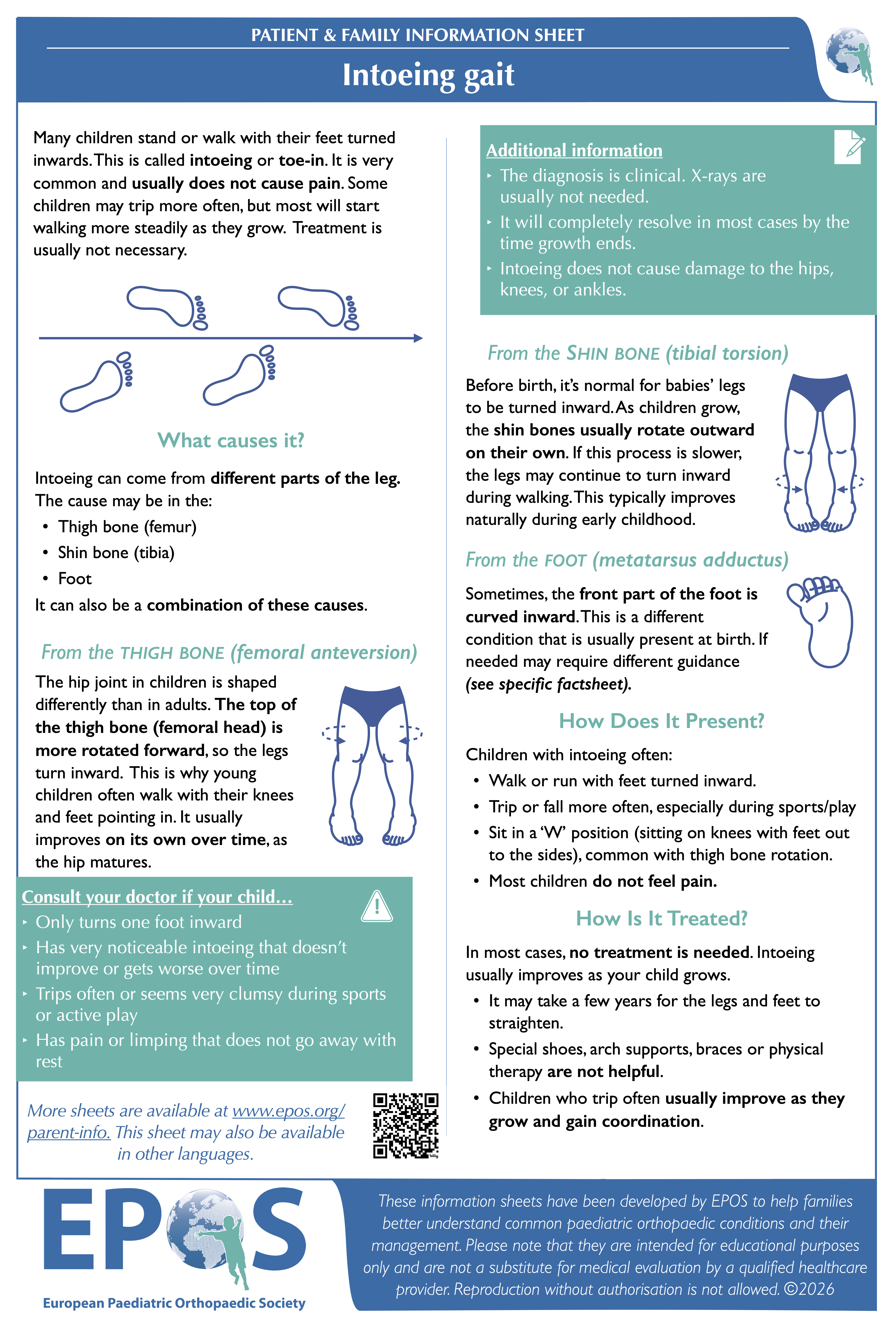
Many children stand or walk with their feet turned inwards. This is called intoeing or toe-in. It is very common and usually does not cause pain. Some children may trip more often, but most will start walking more steadily as they grow. Treatment is usually not necessary.
What causes it?
Intoeing can come from different parts of the leg. The cause may be in the:
- Thigh bone (femur)
- Shin bone (tibia)
- Foot
It can also be a combination of these causes.
From the thigh bone (femoral anteversion)
The hip joint in children is shaped differently than in adults. The top of the thigh bone (femoral head) is more rotated forward, so the legs turn inward. This is why young children often walk with their knees and feet pointing in. It usually improves on its own over time, as the hip matures.
From the shin bone (tibial torsion)
Before birth, it’s normal for babies’ legs to be turned inward. As children grow, the shin bones usually rotate outward on their own. If this process is slower, the legs may continue to turn inward during walking. This typically improves naturally during early childhood.
From the foot (metatarsus adductus)
Sometimes, the front part of the foot is curved inward. This is a different condition that is usually present at birth. If needed may require different guidance (see specific factsheet).
How does it present?
Children with intoeing often:
- Walk or run with feet turned inward.
- Trip or fall more often, especially during sports/play
- Sit in a ‘W’ position (sitting on knees with feet out to the sides), common with thigh bone rotation.
- Most children do not feel pain.
How is it treated?
In most cases, no treatment is needed. Intoeing usually improves as your child grows.
- It may take a few years for the legs and feet to straighten.
- Special shoes, arch supports, braces or physical therapy are not helpful.
- Children who trip often usually improve as they grow and gain coordination.
Additional information
- The diagnosis is clinical. X-rays are usually not needed.
- It will completely resolve in most cases by the time growth ends.
- Intoeing does not cause damage to the hips, knees, or ankles.
Consult your doctor if your child…
- Only turns one foot inward
- Has very noticeable intoeing that doesn’t improve or gets worse over time
- Trips often or seems very clumsy during sports or active play
- Has pain or limping that does not go away with rest
Download the information sheet for intoeing gait
Click on the image below to download the printable information sheet for intoeing gait.