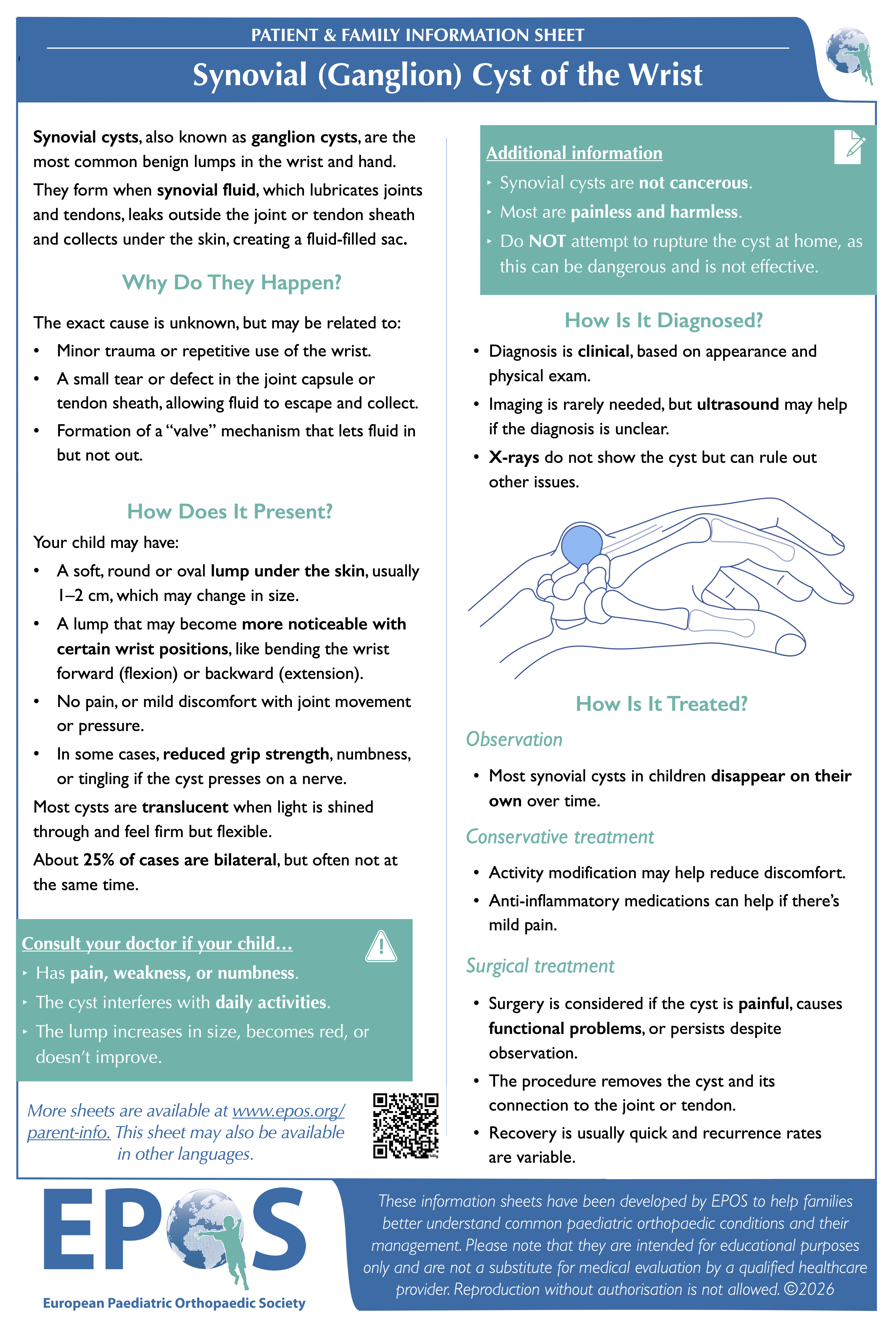
What is a synovial or ganglion wrist?
Synovial cysts, also known as ganglion cysts, are the most common benign lumps in the wrist and hand.
They form when synovial fluid, which lubricates joints and tendons, leaks outside the joint or tendon sheath and collects under the skin, creating a fluid-filled sac.
Why does it happen?
The exact cause is unknown, but may be related to:
- Minor trauma or repetitive use of the wrist.
- A small tear or defect in the joint capsule or tendon sheath, allowing fluid to escape and collect.
- Formation of a “valve” mechanism that lets fluid in but not out.
How does it present?
Your child may have:
- A soft, round or oval lump under the skin, usually 1–2 cm, which may change in size.
- A lump that may become more noticeable with certain wrist positions, like bending the wrist forward (flexion) or backward (extension).
- No pain, or mild discomfort with joint movement or pressure.
- In some cases, reduced grip strength, numbness, or tingling if the cyst presses on a nerve.
Most cysts are translucent when light is shined through and feel firm but flexible.
About 25% of cases are bilateral, but often not at the same time.
How is it diagnosed?
- Diagnosis is clinical, based on appearance and physical exam.
- Imaging is rarely needed, but ultrasound may help if the diagnosis is unclear.
- X-rays do not show the cyst but can rule out other issues.
How is it treated?
Observation
- Most synovial cysts in children disappear on their own over time.
Conservative treatment
- Activity modification may help reduce discomfort.
- Anti-inflammatory medications can help if there’s mild pain.
Surgical treatment
- Surgery is considered if the cyst is painful, causes functional problems, or persists despite observation.
- The procedure removes the cyst and its connection to the joint or tendon.
- Recovery is usually quick and recurrence rates are variable.
Additional information
- Synovial cysts are not cancerous.
- Most are painless and harmless.
- Do NOT attempt to rupture the cyst at home, as this can be dangerous and is not effective.
Consult your doctor if your child…
- Has pain, weakness, or numbness.
- The cyst interferes with daily activities.
- The lump increases in size, becomes red, or doesn’t improve.
Download the information sheet for synovial (ganglion) cysts
Click on the image below to download the printable information sheet for synovial (ganglion) cysts.